


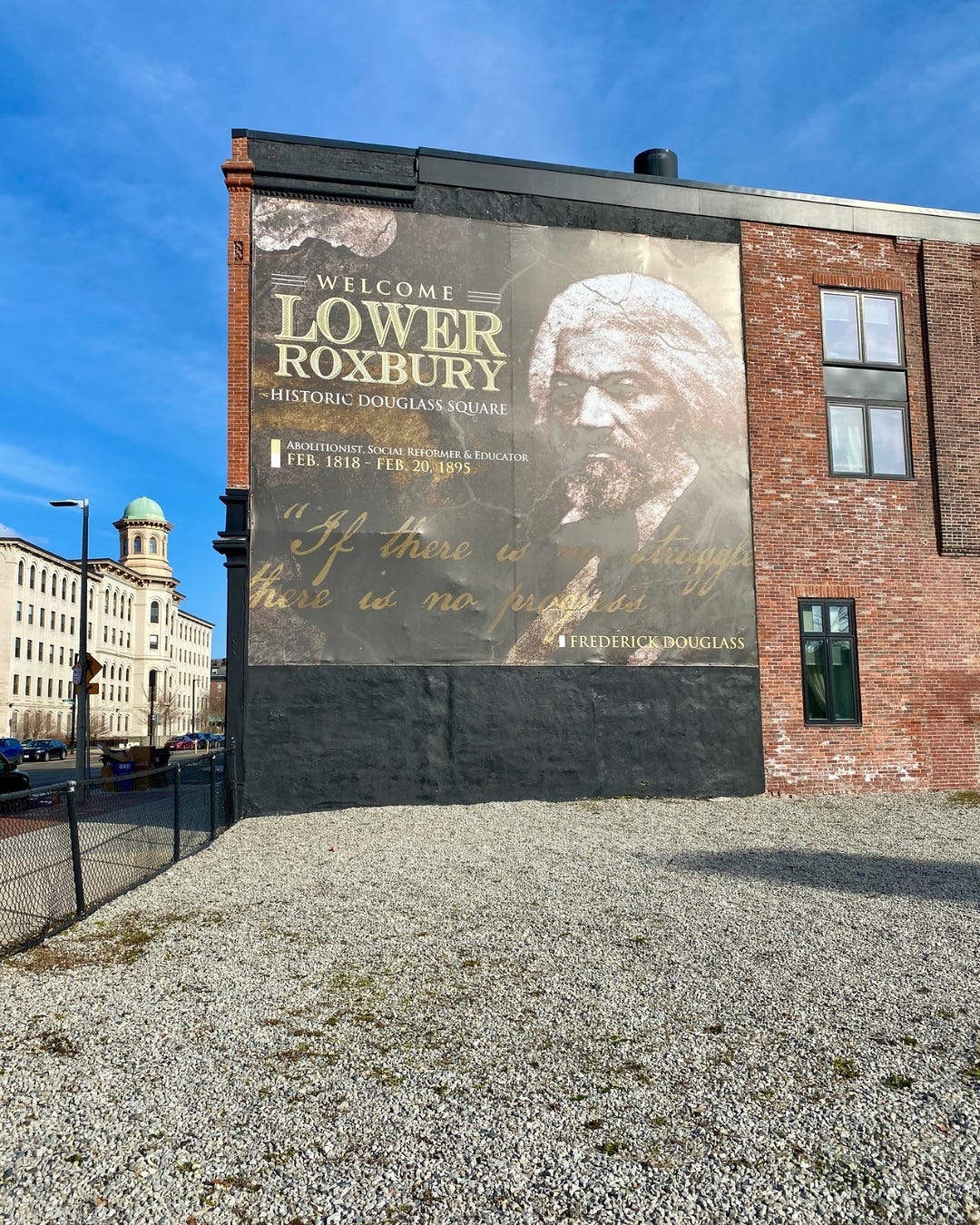
At the corner of Tremont and Lenox, in a neighborhood that was historically Black and is now being absorbed into the high-rent South End, a wall holds a portrait of Frederick Douglass — abolitionist, social reformer, educator, with the dates of his birth and death and the line “If there is no struggle, there is no progress.” The corner has been Douglass Square since 1917.
Within a few blocks sit two developments that tell opposite stories. Douglass Park, built in 1989 and 1990, set aside about a quarter of it’s units as affordable — that requirement runs with the property. The Piano Craft Guild, the old Chickering piano factory, was converted in 1974 into the nation’s first major mill-to-housing project for working artists. Its affordability eventually expired. Two-bedroom lofts now start around $4,300.
Douglass argued his whole adult life that political freedom and economic freedom were the same fight. The vote and the deed, halves of one citizenship. On this corner he looks at two answers to the question he spent his life asking. One affirmative. One not.
The argument is not finished. The wall is evidence.
This is one of four neighborhoods in Painted Claims →.
— Eve Moss
Map & Parcel. Field Notes. May 2026.
Painted Claims

Four neighborhoods. Four murals. What gets recorded in paint, and what gets recorded on the deed.
Map & Parcel™ is a publication of Chavah Media Ltd. This essay is editorial and for general interest only; it does not constitute legal, financial, or investment advice.
© 2026 Chavah Media Ltd. | Map & Parcel™. All rights reserved.